Saturday, January 22, 2011

Cathédrale Notre-Dame d'Amiens (Cathedral of our Lady of Amiens), France

About 100 kms north of Paris, in the region of Picardy's Soome River stands my favourite Gothic cathedral, the one in Amiens.  This magnificent structure was essentially completed in 1266, with the patterned flooring being added later.  Since the architects were, as usual, striving to create something even higher than before, and since the art of countering excessive thrusts from the enormous weight of the gigantic roof and ribbed vaults was imprecise, additional flying buttresses had to be added several hundred years later, and later still, wrought iron chains were installed to keep the enormous stone pillars from buckling (the chain was somehow installed while still red hot, slowly but powerfully pulling things together as it cooled).

We enter from a door on the western front (the main facade), getting our first glimpse of the majestic aisle to the south of the nave.


We pause and turn around to look back outside.


Then we turn left and enter the nave proper for our initial view of the interior of this cathedral, the largest to be completed in the Gothic era (Beauvais was taller but never completed).


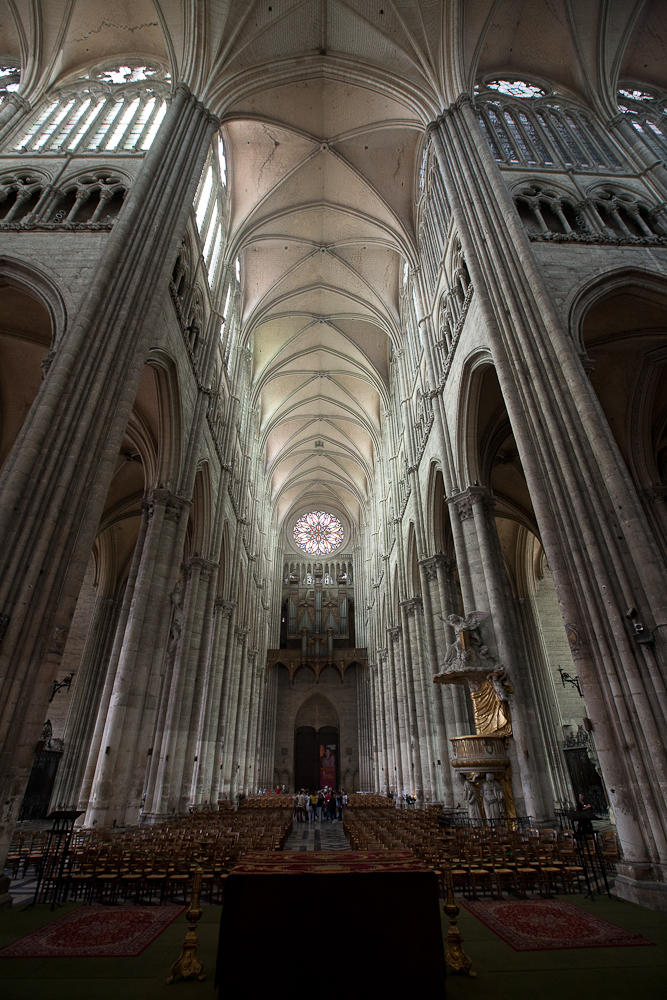
The following view is taken from the transept, looking west toward the back of the cathedral.  Since the perspective of the wide angle lens has not been corrected, we have a sense of the height of the nave's stone ribbed vaulting.
 

We continue looking upward, standing in the ambulatory which goes around the choir and high altar.  We see part of the transept on the left (the white stone wall going toward the upper left corner), the very ornate wood carving (bottom of the photo) which encloses the choir where the monks worshiped about 6 hours/day, the right wing of the transept (darker stone seen through the central arch, seemingly headed to the lower right corner), and the various elevations on the right side, showing that the architecture for the choir/apse is harmonized with that for the nave and transept.


Another view, again from the southern ambulatory, now looking (a bit) through the wrought iron gate through which the monks exited after singing each of the nine Offices (they would have processed into the transept and possibly even nave after celebrating High Mass).

The following photo is another of my favourite types of photos:  those of vaulted ceilings.  This one shows the main nave, with the western rose window on the left, above the mighty pipe organ.  There are 126 massive stone pillars supporting this whole cathedral, pillars designed to carry weight and, at the same time, to assist in admitting light into the sanctuary.  This also gives us some notion of the cathedral's height being divided into thirds of varying sizes:  the lower or ground level aisle, the more narrow triforium (the walkway directly above the aisle) and the magnificent clerestory windows which are 12 meters tall, or nearly 1/3 of the total interior height.


The next photo shows the vaulted ceilings meeting at the crossing, where the transept (above and below the centre) intersects with the ceilings of the apse (right) and nave (left).  Adding the gigantic clerestory windows just under the vaulted ceiling significantly increases the available natural light.


A more typical view shows the vaulted ceiling of the apse, the original blue rose window at the eastern end (notice how much darker its vault appears), and light flooding the vaulting from the gigantic clerestory windows.


Some of the windows are still filled with stained glass from the 13th c., others are either clear, or have bands of coloured glass (gleaned from destroyed windows?)  Most admirers of cathedrals adore stained glass windows, but I find them difficult to see and too often too dark, particularly on dreary days.  My soul basks in sunlight.

Below we see light coming through a southern clerestory window which is essentially clear glass, decorated with bands of coloured fragments of earlier windows (or newly created for these windows).


As we move away from individual windows, the general aspect of light itself becomes a primary theme as it outlines the 'bones' of the structure, the graceful slender archways branching out, offering visual support to each part of each vault in the ceiling.

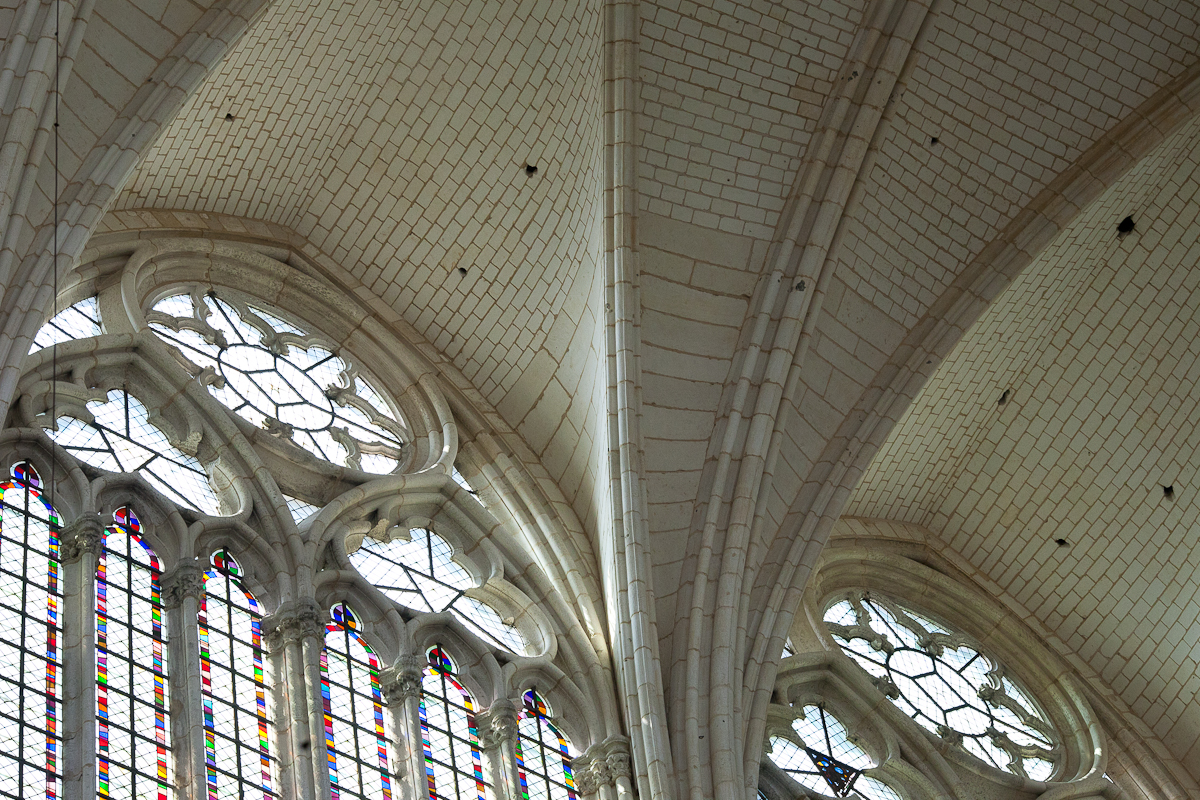


A modest telephoto lens seems to give us visual admission to the triforium, that upper walkway directly above the southern aisle which runs parallel to the nave and helps to provide it light through its two sets of three arches.  One of the joys of the Amiens Cathedral during a bright day is that little if any additional lighting is required.  This gives one a sense of how the cathedral would have looked in the late 13th century, something we almost never experience in Paris or Chartres.


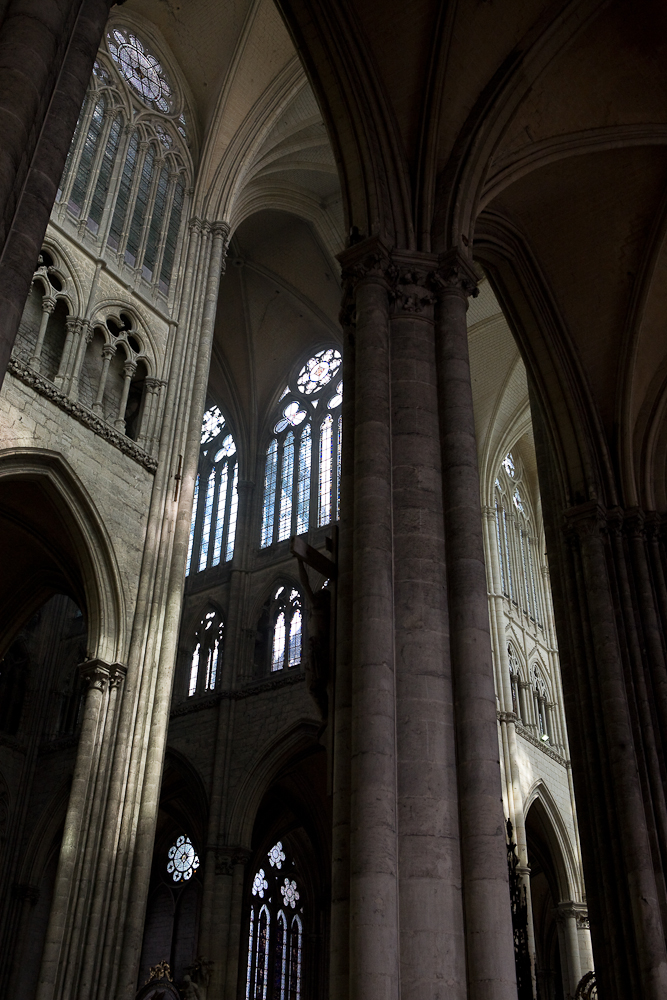
The following photo gives a view which better shows the largest and lowest archway (through which the photo is taken) which, on the opposite side, is then subdivided at the triforium (middle walkway) level into two arches, which in turn are subdivided into threes.  Above all of this tower the clerestory windows, a full 12 meters tall.


In the late afternoon, sunlight can shine directly on various parts of the cathedral, particularly the flooring made of polished stone.


Otherwise austere walls with statues (some partially destroyed) come alive when bathed in sunlight.



Where the stained glass windows survive, the intense colours of the various panes are reflected on the tiled floors.


Gothic cathedrals were apparently very colourful indeed, with intense colours in the windows, on the stone ribs holding up the vaulted ceilings, on the vaults themselves (sometimes painted blue with gold stars).  Some of these historic patterns can be discerned through a careful microscopic examination of the remaining isolated flakes of paint, some are reasonably well preserved and more easily recreated, and others are of more modern design.


The tiled floors were completed by 1288.  Various patterns are used.  We see three distinct patterns here, each being used to help articulate the cathedral's structure, one pattern running from pillar to pillar (along the northern arm of the transept), another directly under each vault in the side aisles, and still another in the nave.  The swastika (a modified form of the cross) symbolized Jesus triumphing over death.


By 1288, the wonderful labyrinth was completed in the centre of the nave.  As with those in other cathedrals, the labyrinth's path can be walked (or one can crawl) as one undertakes this miniature pilgrimage at its beginning, and then walks quietly, slowly for the next 15-20 minutes, all going in one direction while contemplating life, meditating, or possibly recalling the millions of pilgrims who had come to this shrine which was thought to house the severed head of St John the Baptist.  I was gratified to see that the cathedral had kindly cleared all chairs from the labyrinth so that modern pilgrims could tread its course.


Some just read about it.


At various places, the devout are encouraged to pray.  Here, for instance, we read that

The most illustrious and reverend Monseigineur, the Bishop of Amiens
has granted 40 days of pardon [indulgence] to all for the devout saying of 
three 'Our Fathers' and a 'Hail Mary'
in honour of the Virgin and for the repose of the dead.


Baroque altars can also be found where one is encouraged, by subject and by the art, to pause, reflect, and hopefully pray.

 
Candles can of course be purchased and burned either in memory of someone, as an act of devotion, or in prayer.


Wrought iron candle holders are provided throughout the cathedral, reminding us that electricity is a relatively new invention.


Ancient (cold) stone seating is provided here and there, possibly for the elderly, and certainly for the weary who find respite in admiring the cathedral while being seated.  The notion of people sitting during Mass is relatively modern.  For centuries, believers stood, quietly and most devoutly, for a very long time indeed.


Sunday, January 9, 2011

Vancouver Cityscapes from Granville and Burrard Bridges

The clouds changed constantly as the cold wind blew in gusts.  Several times I clutched a pillar, trying to hold the camera still on the wind-swept bridge.  On days like this, Vancouver can be exceptionally beautiful as the sun strikes one group of buildings, and then another, but never all of them at the same time.  (All but the final photo were taken from the Granville Bridge.)


Looking west, from the Burrard Bridge


Tuesday, January 4, 2011

Champs-Élysée, Nature Capitale

First, a reminder of how the Champs-Élysée normally looks, with traffic whizzing around on its six lanes which stretch from La Defense to the Louvre, passing the Arc de Triomphe at the midway point.


The Champs-Élysée is important to all biking enthusiasts because it invariably hosts the conclusion to the world's most famous bike race, the three-week Tour de France, which I follow faithfully from Canada.  I forget how many laps the riders take up and down this street, but they go flying at speeds which are absolutely frightening, particularly on those cobble stones.  Some exceptionally brave riders leading the pack may briefly ride in the gutter on the side of the street because those granite stones are more smooth, but if a right pedal should touch the curb, it's curtains.  My shoes (below) give a bit of perspective to the size of the gutter, likely no more than a foot wide--hardly the space one desires when biking at 50 km/h or more.  I forget what the red shells were, but they gave the sense of walking on soil rather than on a wide street paved with granite cobblestones.


We started at the eastern part so that we could walk with the sun to our backs rather than in our eyes.  We were greeted with an enormous pyramid of boxes of all sorts of fruits and vegetables.  In part, the display was advertising wooden crates.  By 10:30, the lettuce at the very top was already starting to get a bit limp in the hot sun, but the colours were wonderful against the blue sky. 


At this point in the exhibition, cars were still allowed on the road, but there seemed to be a hundred or more tents along the sidewalk with displays of all sorts, mostly food producers showing their wares, cheese, milks, meats or talking with people.  


I enjoyed a display of barley ready to be harvested.  This was actually a carefully constructed series of boxes with styrofoam in the bottoms, into which people had carefully inserted each and every dry stalk of barley.  It was a labour of love and gives one the impression of a field in late summer.


We eventually came to the final grand stretch which was devoted only to pedestrians.  Apparently the Champs Élysée was closed to traffic the previous night at 10 p.m., when untold numbers of trucks descended, with goodness knows how many workers, to set up everything by morning.  Possibly a km of the street was taken over by great big boxes of living vegetable plants and even cattle, sheep, goats, olive trees, vineyards from various regions in France.  Something like that happened 20 years ago, but that display was entirely devoted to wheat.  I remember seeing pictures of large combines harvesting wheat on the Champs Élysée and thought the photo was a fake.  I underestimated the French passion for excellent wheat.  This time, many more groups of producers of food were involved.  First, a quiet shot of people walking parallel to the Champs-Elysée, under the trees.  We often sought the shade.


I doubt that this was a working bee hive.


It does seem strange to see steers eating in the middle of the most famous street in all of France, but this is the only way most Parisian children (and adults) can come into any sort of contact with the source of their food.  Food is so important to the culture of France.  It is not uncommon to give a full three hours to a leisurely dinner, slowly going from course to course, with lots of conversation.  The French pay a much higher percentage of their earnings for food than we do, but then their food is really superior to ours. 


Heinichen's workers explained the importance of hops, barley, etc. for making beer.  I liked the intensity with which people listened.


Lest there be any doubt, this was a popular event.  One saw a sea of humanity enjoying the displays.


If you were willing to wait long enough, you could get a lift above the crowds and take photos.


The above lift, seen from a distance:

Alsatian vines


Saturday, January 1, 2011

Arc-de-Triomphe, Place Charles de Gaulle, Paris

 The Arc de Triomphe (Arch of Triumph) is one of a number of spectacular monuments on the long boulevard going from the Louvre to La Defense.  A paraphrased translation of an inscription explains at least some of its genesis:

This monument, begun in 1806 in honour of the Grande Army, 
interrupted for a longtime and then continued with new dedication in 1823,
was completed in 1836 by King Louis Philippe I, who consecrated it to the glory of the French Armies.


The monument is 50 metres high, and the largest vault is 29 metres high (just under 100 feet)--large enough for Charles Godefroy to fly his plane through when celebrating the end of WW I. 


Inscriptions covering much of the outside recall each of the battles and generals of the Napoleonic wars, and there is a tomb to an unknown French soldier killed in WW I.


There is no elevator, but winding stairs let us climb the 160 feet and get some glorious views of the city.


Once you are nearly at the top, there is a large room with a number of displays, including the inscription with which this entry began, photographs and a model of the monument as designed by Jean Chalgrin in 1806.


Visitors going to the open top of the Arc de Triomphe have excellent views through a tastefully designed protective fence (which is photographed repeatedly daily).


From the top, one can step up onto an outer walkway which goes around the entire structure.  These photos show just a few of the city's monuments as seen from this vantage point.  Haussmann did indeed redraw much of Paris so that major roads radiated in all directions from this hub, like so many spokes on a wheel.  The resulting gigantic roundabout could create some "interesting" traffic patterns, but everything is orderly.


We are now looking east, along the famous Champs-Élysée which leads to the Louvre, formerly a palace and now a grand museum.


The following view shows Sacré-Coeur on the distant hill.
 

A telephoto lens brings into view the ancient Egyptian obelisk from the temple for Ramses II at Thebes.  This obelisk, more than 3,200 years old, now stands in the centre of the Place de la Concorde (Peace) about halfway between the Arc de Triomphe and the Louvre.  Behind "Cleopatra's needle" (the obelisk) is the sprawling Louvre, now housing both a museum and government offices.


In the following photo, we can catch a glimpse of the Notre Dame Cathedral with its two square towers and 19th-c spire, and in the foreground, the beautiful Grand Palais des Champs Élysée, built for the Expo in 1900.  This was the last such structure of glass to be built in imitation of London's Crystal Palace. Just beyond the Grand Palais you can see the low-lying Musée D'Orsay with its curved roof, formerly a railroad station, now my favourite museum in Paris.


The following photo shows the Baslilque de Sacre-Coeur (Church of the Sacred Heart) on the hill in the upper left corner, and the mid-19th century Église Saint-Augustin de Paris (Church of St Augustine).


Again, Sacre Coeur, seen over thousands of roof tops and chimneys.


Looking down, people are heading to their favourite cafés and restaurants, some with sidewalk tables under awnings.  The trees of the Champs Élysée have been carefully squared for the summer.  You will also appreciate the regulation that no new building in Paris can be more than about 6 floors high.  This gives a uniformity to the city, and lets the principal monuments appear more grand than if they were surrounded by modern skyscrapers, as is the case for poor St Patrick's Cathedral in New York City.


Finally, we look away from Paris proper, toward the west, where La Défense can be seen in the distance, and the Bois de Boulogne (Boulogne Woods) stretching from the left toward the centre of the photo.