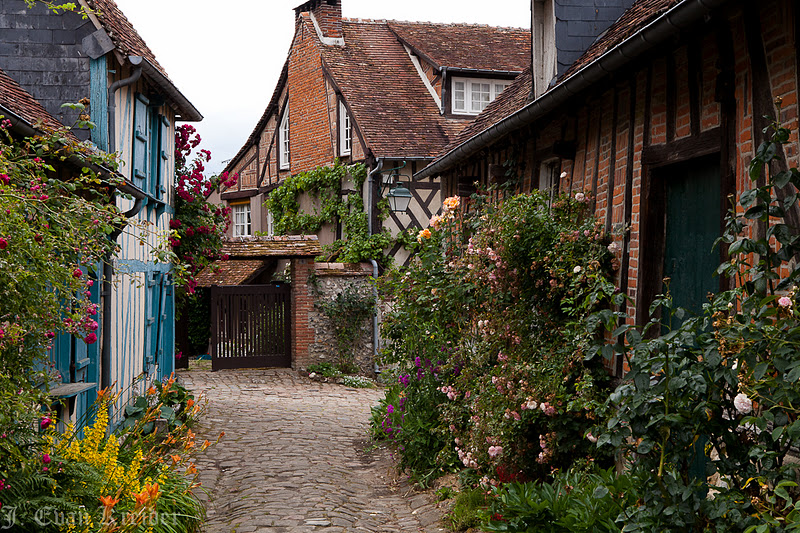
The beautiful medieval town of Gerberoy is now known as the "Village of Roses". Royal permission was granted in 1202 enabling Gerberoy to be called a 'Ville'. It is located in the present département of Oise in Northern France (Picardy), in the center of a triangle formed by Beauvais, Amiens and Rouen, one of the theatres for the disastrous Hundred Years War.
Now classified as one of the 'most beautiful villages in France', this formerly neglected farming village was rediscovered in 1901 by various artists, including Auguste Delaherche and Henri le Sidaner. Sidaner's avid interest in roses led him to plant them everywhere, not just at his home but all around the village, the ancient fort ruins, along paths leading into the village, everywhere. Before long, citified retirees discovered the charm of the village's old half-timbered structures from the 17th and 18th centuries and its buildings made of brick, as well as the wonderful views the village offered of the surrounding lush farmland.Begun in 1928, Gerberoy's famed Fête des roses now attracts thousands of tourists annually. If you can visit Gerberoy on the third Sunday of June, you will see the village's flowers at their peak, during this festival. (These photos were taken in the afternoon of June 14th, 2011, at the end of a very dry spring; rains were just returning.)
Showing posts with label roses. Show all posts
Sunday, November 20, 2011
Tuesday, September 30, 2008
Abbaye de Valsaintes, Provence, France


The Abbaye de Valsaintes was a Cistercian abbey, part of which dated from the 12th century. Cistercians were cloistered (remaining within the walls surrounding their property), and after being founded in 1098, the monastic order spread rapidly during the 1100s, partly under the influence and prestige of St Bernard of Clairvaux. The location selected for the Abbaye de Valsaintes was typically isolated in the mountains, offering inspiring views across valleys and mountains, an ideal location for men wanting to withdraw from politics and worldly influences for a very demanding life of prayer, meditation and unbelievably strict discipline.
The French Revolution essentially ended many centuries of monasticism throughout France. Monasteries and abbeys were forcefully emptied, lands confiscated by locals, buildings either fell into disuse or became barns for local farmers, most roofs disintegrated after decades of neglect, and even the once sturdy stone walls succumbed to disrepair as they endured several centuries of wear.
More recently, Serge Orlandi purchased these ruins, moved to the property with his family, living in trailors and slowly restoring the beautiful chapel and the grounds of the former abbey. He believed that this beautiful location had been important to pre-Christian religions and that markings on sandstone rocks and the positioning of cone-shaped rocks throughout the property indicated that drudic practionners had worshipped here centuries before monks arrived. He has therefore sought to establish a place for meditation (with no specific religious connections) and carefully constructed and reestablished terraced gardens for thousands of roses. Even though we visited toward the end of the season, many plants were still in their glory. This former ruin is definately worth a visit for gardening enthusiasts.
Subscribe to:
Posts (Atom)