Saturday, January 28, 2012

Vancouver Chamber Choir Rehearsal

I was able to attend the dress rehearsal for the Vancouver Chamber Choir's recent very successful concert at Ryerson United, Canticum Canticorum, Renaissance music based on verses from the Song of Songs.  The choir very kindly let me photograph throughout the rehearsal and ignored my prowling about, standing on pews (shoes removed), etc.  Steven suggested that I try to give a sense of individuals during a rehearsal, rather than the more typical formal shot of an entire choir at a distance.  This choir has very talented singers with amazing powers of concentration.  You should hear them sometime. 


Monday, January 9, 2012

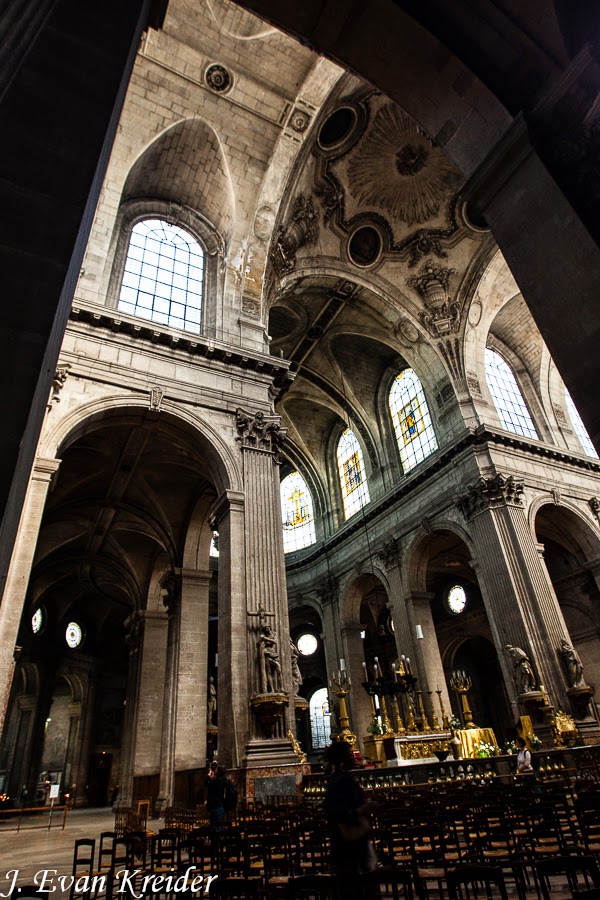
Église Saint-Nicolas-des-Champs, Paris

The Église St-Martin-des-Champs (Church of St Martin of the Fields) is in the 3rd arrondissement on the right bank of Paris, 0.2 kms from both the Hôtel de Ville and Châtelet métros.  The original chapel was quite modest, dependent on the St. Martin's Abbey (now the Musée des Arts et Métiers).  In 1184, the chapel was rebuilt as the principal place of worship for the newly-created parish for Beaubourg, people living around the Abbey and undoubtedly earning at least some of their livelihood by working for it.  Designed in the flamboyant Gothic style, it has been constructed in stages over a considerable time, with special building campaigns surfacing in the 12th, 15th and 17th centuries.  In 1793, in keeping with the truly bizarre thinking of the radicals leading the Revolution, this beautiful church was designated as the Temple to Hymen and Fidelity.  Once the excesses of the radicals were no longer tolerated, the church reverted to its original function, as a place of worship (1802).  Today, it is the headquarters for a very active parish.  During my visit in May of 2011, there was special interest in the progress of the canonization of John Paul II.


Wednesday, January 4, 2012

Former Cistercian Abbaye Notre Dame de La Grâce-Dieu, Doubs, France

The former Cistercian Abbey, L'Abbaye Notre Dame de la Grâce Dieu is nestled in a wooded valley created by the Audeus River about 30 kms east of Besançon.  This was the 11th monastery to be founded by Citeaux, one of four Cistercian mother houses. The abbey's official founding date, March 25, 1139, would have marked the beginning of the New Year in certain secular calendars, but more importantly to the Cistercians, it was the Feast of the Annunciation.  Granted land by the several of the local nobles, founding and maintaining the monastery on this undeveloped land proved arduous.

Its original 12th- and 13th-c. Romanesque  buildings suffered destruction as opposing armies passed through the valley, particularly during the religious wars of the 1500s and early 1600s.  In 1653 Rome decreed that several aspects of Jansenism, a rapidly-growing movement among some French Catholics, was heretical, and since the Abbaye de la Grâce-Dieu had agreed with other French Catholics interested in this line of thinking, they suffered.   

Approaching the abbey, crossing a river.

Gated carriage entrance to the abbey


Entering the initial enclosure


Looking across the truncated nave.


Members start to gather in choir for daily evening worship.
Over the centuries, various buildings have undergone reconstruction, including the water mill (which was crucial to the locals), the hotel (which housed visitors), and the Neo-Gothic sanctuary (which was rebuilt in the mid 19th century).  In 1995, the Abbey was officially designated as an historical monument.

The abbey has needed to be repopulated from time to time.  When Cistercians from the Abbaye Port Royal des Champs had outgrown their facilities, some of the monks moved to help out at La Grâce-Dieu.  But it was this group which later came under suspicion for its Jansenist leanings in the mid 1600s, and felt the wrath of Louis XIV.

This impoverished old abbey then suffered severe flooding in 1759, and its monks were forced to leave yet again.  But even worse ordeals came with the French Revolution, which gave vent to resentments against all monastic establishments.  Locals were finally emboldened to break down the Abbey's doors and to pillage at will.  Once the Revolution was consolidated, decrees were issued from Paris which instructed that the abbey's furniture be sold, as well as its forests, mill, and other buildings.  The forge, which was installed in the resonant chapel, must have produced deafening noise.  

Half a century later, the secular owners put the former abbey on the market (1844), when it was repurchased by Cistercian monks, this time from the Val Sainte Marie.  They restored the chapel and other buildings.  Within decades, declining numbers prompted them to leave (in 1909), and they were eventually replaced by Cistercian sisters (1927).  By 2010, this group of nuns dwindled to 12 aging nuns, so they were asked by the diocese to join other Cistercian nuns at the Abbaye d'Igny.   Les travailleuses missionnaires de l'Immaculée de la Famille (now called the Famille Missionnaire Donum Dei) has taken over the former abbey.  This lay order (Third Order) of Carmelites uses the facilities for a 6-year course of rigorous training for novices interested inbecoming full members, who then work at secular jobs but remain celibate, live in a common life (sharing goods and incomes) and meet several times daily for worship.
We visited the former Cistercian abbey late afternoon on June 4th, 2010, arriving in time to walk alone on the public grounds briefly before hearing the novitiates sing Evensong in the simple but beautiful Neo-Gothic chapel.  Only the choir and crossing of this former abbey church now stands, but its acoustics are perfect, even when the untrained laity sing chant.  We heard 5 men and 18 women sing, but the music was decidedly best when only the women sang.

Wednesday, December 28, 2011

Basilique Notre-Dame des Victoires, Paris

The Basilica (sometimes called Église or Church) of Our Lady of Victories is located in Paris, in the 2nd arrondissement near the Stock Exchange (Rue Notre-Dame des Victoires; the nearest métro is Bourse).

Augustinian monks (sometimes then known as Les Petits Pères, the Little Fathers) had purchased the property in order to build a convent and place of worship.  Almost immediately after dedicating the grounds, Louis XIII agreed to finance the church if it were dedicated to the Virgin Mary, to whom he credited his recent important military victory over the Protestants in the lengthy siege of La Rochelle (September 10, 1627-October 28, 1628).  Construction began in 1629, but a serious lack of royal funds stopped all work until about 1656.  The incomplete church was dedicated in 1666 and the basilica was finally completed in 1737.  Ironically, shortly after the Revolution (50 years later), the basilica which was built in honour of Catholicism's victory over Protestants was then emptied of Catholics in order to house the national lottery and stock exchange.  However, under the First Empire (10 years later), it reverted to being a place of worship for the local parish.

As you walk through this basilica, you are immediately struck by all the white marble plaques thousands of individuals, most of whom donated a plaque in thanksgiving for the Virgin's help during their military service in various wars, local and foreign, particularly during the 1800s.  Entire walls and even a few arches are now covered with more than 36,000 plaques.  Some are explicit and dated, others only allude to having been helped by Mary.

I recalled two salient things when observing and enjoying this church:  (1) Although I am a practicing Protestant, there I was, photographing a church built in thanksgiving for the defeat of  some Protestants, and (2) although I, like so many of my ancestors, am a pacifist, there I stood, looking in amazement at 36,000 expressions of thanks, many of which concern the granting of personal safety while being hired (or conscripted) to kill others.  As these two ironies sank into my thinking, I stopped to offer a special prayer that all Christians will seek to be more Christlike, and that all wars will cease.