The parish church now know as Saint-Louis-en-l'Île is tucked away on the small Île-Saint-Louis (métro Pont Marie), the island just east of the larger Île de la Cité, the more important island dominated by the Cathédral Notre Dame de Paris, Sainte-Chapelle, the Palais de Justice de Paris, and various government offices. Most tourists know of the the smaller island because of its reputation for having the very finest ice creams, but there is another gem, the parish church Saint-Louis-en-l'Île.
In 1642, Louis XIV decided to build a larger parish church on the site of the former Notre-Dame-de-l'Île, using plans drawn up by François Le Vau, who was also designing Versailles. Louis Le Vau undertook construction of the choir in 1664 until funding ran out in 1679. Work on the nave and transept resumed in 1702 and was completed in 1726. Closed by the French Revolution, it was eventually purchased by the City of Paris in 1817, restored, and has remained open ever since, both for worship and concerts.
 |
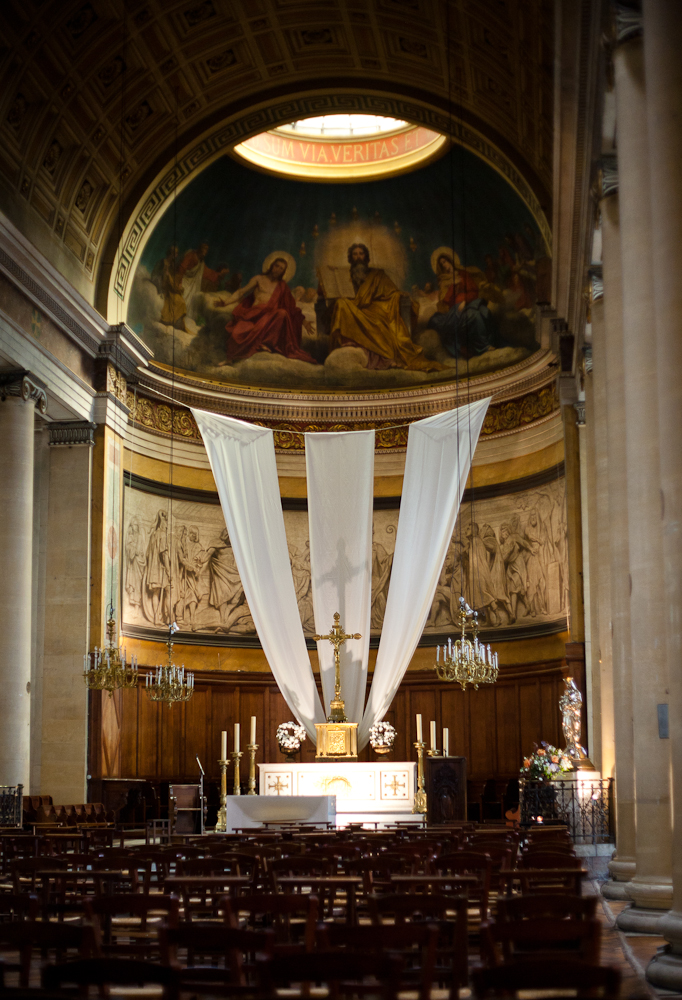
| Looking directly toward the altar, elevated pulpit on the left. |
 |
| Elevated pulpit with wooden stairs. |
 |
| After Mass, the remaining hosts (wafers) are kept in a side chapel, where one can pray. |
 |
| Looking from transept down the south aisle and into the nave toward the altar. |
 |
| Closer view of the new front altar and the older high altar. After Vatican II, the altar was moved closer to the congregants. |
 |
| Looking across the choir, wooden choir stalls on the right, newer altar on the far right and high altar on the left. |
 |
| Looking across the choir stalls toward the high altar. |
 |
| From behind the high altar, looking toward the dome above the crossing where the transept intersects the nave. |
 |
| Looking across the choir, over the wrought iron fencing which outlines and protects the inner choir area (off limits to laity). |
 |
| The ambulatory (walkway around the choir) has a series of chapels on its outer side. |
 |
| This side chapel has a plaque listing each curé (priest) for the parish and the dates of his tenure. |
 |
| The side chapels off the apse and directly behind the high altar are more elaborate. |
 |
| Wonderful candle holders to illuminate the aisle. |
The gallery tracker organ with mechanical action was made by Aubertin (2004, 51 stops, 69 ranks) and is located in the gallery at the back of the nave.
The second organ is the chancel organ with electrical key action was made by Gutschenritter (1965, 20 stops and 20 ranks). Having electrical key action, its console can be located anywhere in the sanctuary. The present placement is in the north part of the ambulatory, allowing the organist to observe the action at either altar and improvise his music accordingly, timing the improvisations so that they end precisely when the celebrant completes his tasks.
 |
| The console for the chancery organ is on the left and the ranks of pipes on the right. |
Soon after the Concordant which enabled churches to be reopened after the anti-religious fervour of the Revolution subsided, Pope Pius VII came to Paris to crown Napoleon on December 2nd, 1804. With the many parish churches attempting to reopen, the pope remained in Paris for about 17 weeks, visiting numerous parishes and encouraging Christians as they tried to reorganize logistically and economically. On March 10th, 1805, Pope Pius celebrated Mass in Saint-Louis-en-l'Île.